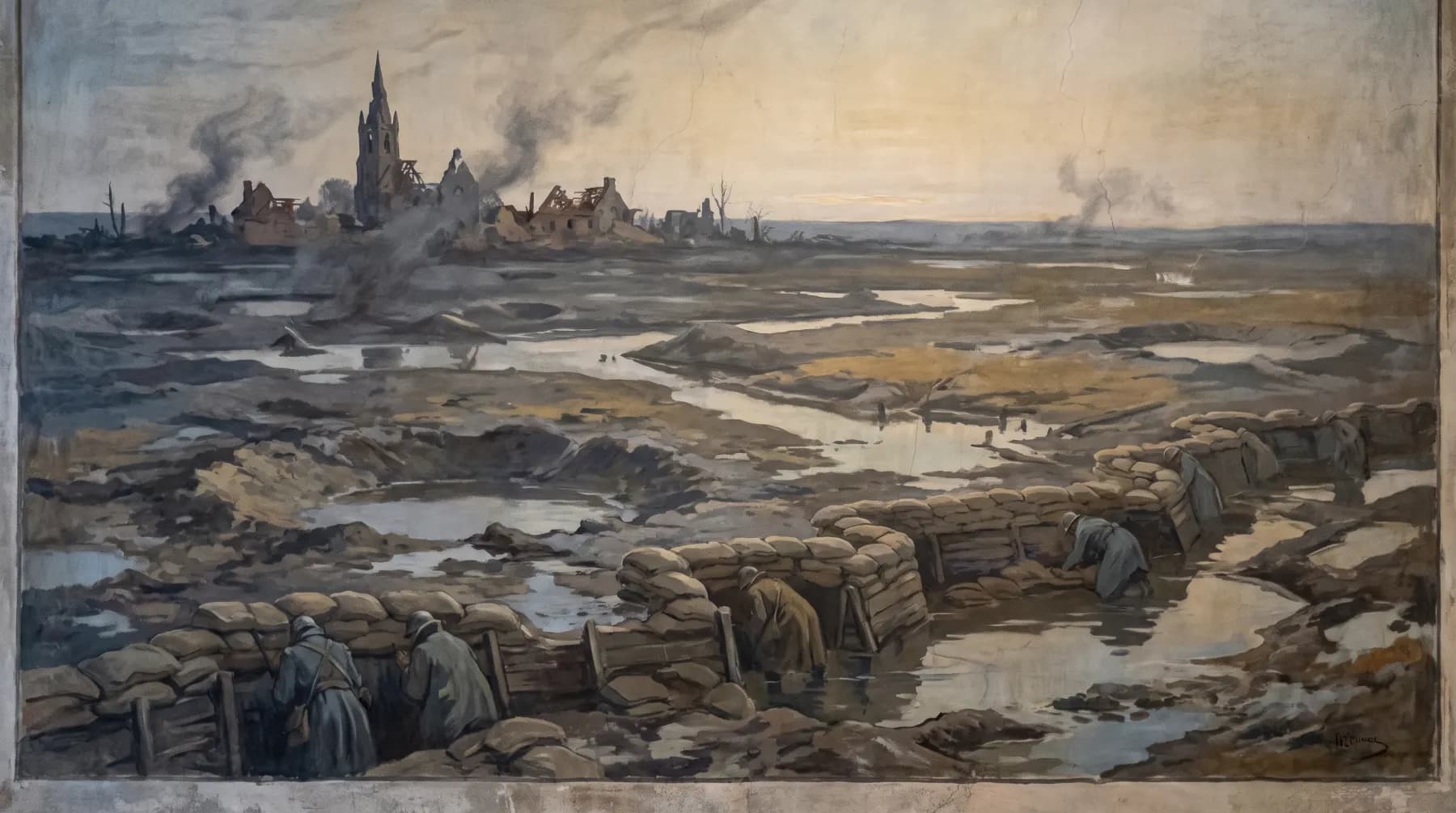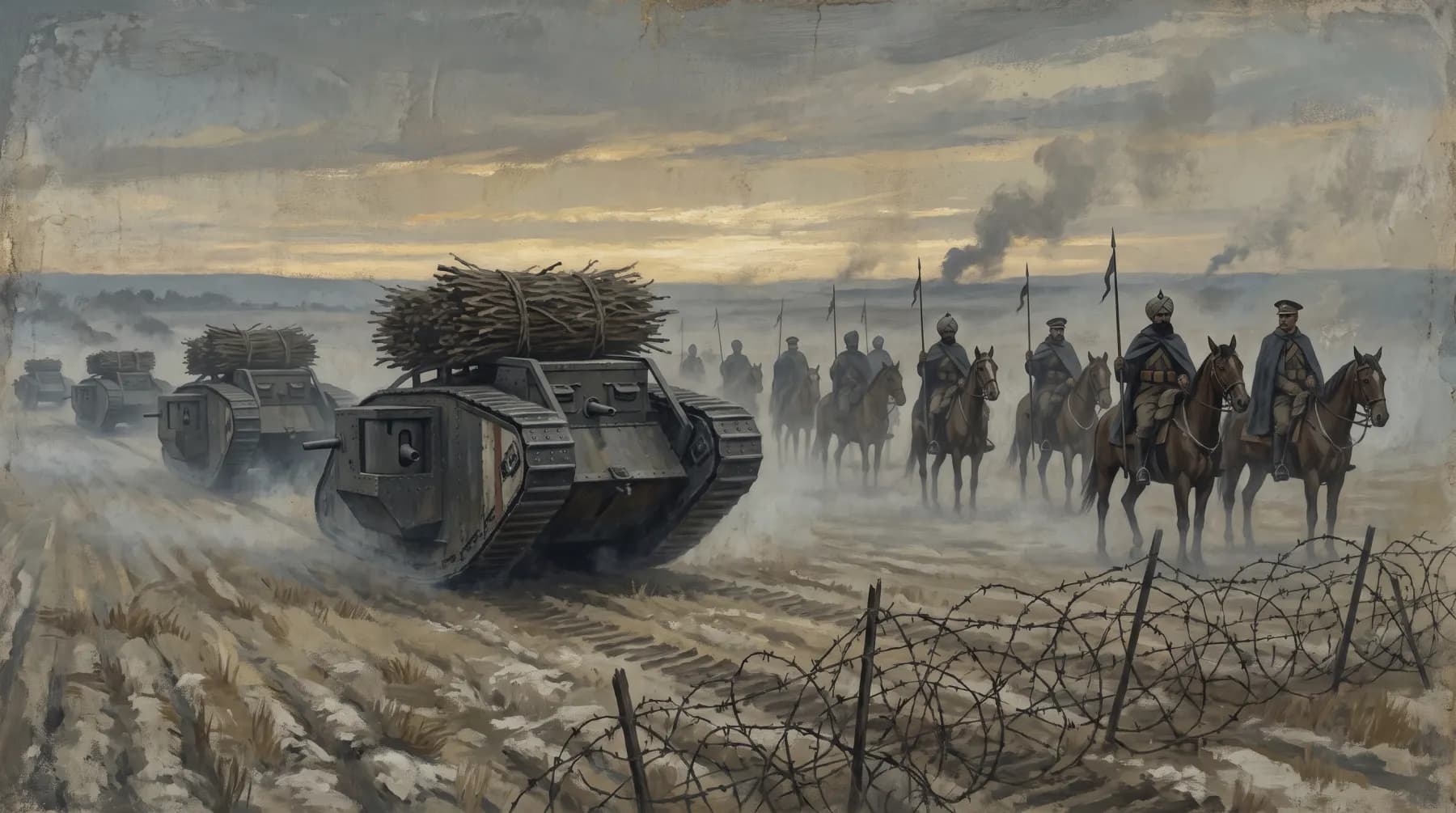
Painted reconstruction of Mark IV tanks carrying fascines advancing through dawn mist at Cambrai, with a column of mounted cavalry in turbans and peaked caps waiting behind a belt of barbed wire.

20 November – 7 December 1917

The Battle of Cambrai

Indian and Canadian cavalry in the first mass-tank offensive

The first battle to commit massed tanks against a fortified trench system, and the clearest case of Indian and Canadian troops serving inside a single division. Canadian cavalry rode through the breach at Masnières; Indian cavalry stopped the German counter-offensive ten days later at Gauche Wood.

Artistic historical reconstruction

Dates
20 Nov – 7 Dec 1917
Where
Cambrai, northern France
Indian formation
5th Cavalry Division
Canadian formation
Canadian Cavalry Brigade
Tanks committed
More than 400
Victoria Crosses
Gobind Singh · Harcus Strachan

Why this battle is here

At Cambrai, Indian and Canadian mounted troops shared one divisional commander, one operational plan and, in the end, one desperate defence — the most direct evidence of shared service that this memorial commemorates.

01 — OVERVIEW

A turning point in how war was fought

Why Cambrai mattered, and why it matters to a memorial commemorating Indian and Canadian service.

The Battle of Cambrai was a British Third Army offensive against the German Hindenburg Line west and south-west of Cambrai, an important German rail, road and supply centre in northern France. The operation opened on 20 November 1917 and continued through a German counter-offensive and British withdrawal in early December. Canadian official battle-honour nomenclature treats “Cambrai, 1917” as 20 November to 3 December, within the wider Cambrai Operations of 20 November to 7 December.

Cambrai is remembered as a turning point in the development of combined-arms warfare. Instead of a long preliminary bombardment, the British relied on surprise, predicted artillery fire, massed Mark IV tanks, infantry trained to move closely behind the tanks, aircraft, engineers, and cavalry held ready to exploit a breach. More than 400 tanks were committed in the wider operation, and the opening attack achieved a penetration of roughly four miles in several sectors.

Why this battle belongs here

For Indian and Canadian military history the battle is especially important, because the 5th Cavalry Division contained two cavalry brigades built around Indian Army regiments and the Canadian Cavalry Brigade. The division therefore placed Indian and Canadian mounted troops inside the same operational formation.

During the opening attack the Canadians attempted to exploit the breach around Masnières. During the German counter-offensive, Indian cavalry fought both mounted and dismounted, including hard fighting around Gauche Wood and Villers-Guislain.

Painted reconstruction: Mark IV tanks carrying fascines advance through dawn mist while cavalry in turbans and peaked caps wait behind barbed wire.
Dawn, 20 November 1917. Tanks carried fascines to bridge the Hindenburg Line's wide trenches; the cavalry waited behind for a breach that never fully opened.Artistic historical reconstruction

02 — OBJECTIVES

What each side set out to do

British, Indian, Canadian and German aims at Cambrai, and how the Indian and Canadian missions changed when the breakthrough stalled.

British and Allied objectives

  • Break through the Hindenburg Line by surprise rather than by prolonged preliminary bombardment.
  • Use massed tanks to crush wire, cross trenches and neutralise strongpoints so infantry could advance quickly.
  • Secure the St. Quentin / Escaut Canal crossings around Marcoing and Masnières and open routes for cavalry.
  • Send the Cavalry Corps through the breach to isolate Cambrai, disrupt German headquarters, artillery, communications and rail movement, and threaten the rear of the German position.
  • Capture commanding terrain around Flesquières Ridge, Bourlon Wood and Bourlon Ridge, then consolidate a defensible salient if a complete breakthrough proved impossible.

Indian cavalry objectives

As part of the 5th Cavalry Division, the Secunderabad and Ambala Brigades were to exploit the tank-and-infantry breach as soon as III Corps secured the Marcoing and Masnières crossings and opened the Masnières–Beaurevoir Line. Their operational mission was the Cavalry Corps mission: sweep east and north of Cambrai, isolate the town, block exits and communications, seize crossings over the River Sensée, and help cut off German troops still holding the Hindenburg Line west of Cambrai.

When the breakthrough stalled, the Indian mission changed from exploitation to emergency defence and counter-attack. On 30 November the Ambala Brigade was ordered to drive back German forces north of Épehy; 9th Hodson's Horse supported the leading 8th Hussars, and the 18th Lancers moved up as reserve, relief and reconnaissance troops near Gauche Wood.

On 1 December the 18th Lancers, fighting dismounted, were ordered to follow tanks into Gauche Wood and push toward its eastern side, while the Mhow Brigade of the 4th Cavalry Division — including 2nd Lancers (Gardner's Horse) and 38th Central India Horse — counter-attacked toward Gauche Wood and Villers-Guislain to stop the German counter-offensive.

Canadian cavalry objectives

The Canadian Cavalry Brigade shared the 5th Cavalry Division's opening exploitation mission. Once the infantry had forced the canal and rear defensive line, the brigade was to pass through the breach, sweep around Cambrai from the east and north, isolate the town and help secure the Sensée crossings.

Fort Garry Horse served as the brigade advance guard on the Masnières route. Its immediate task was to get through the canal crossing and into open country before German reserves could close the gap; one squadron succeeded in crossing and penetrating behind the German line.

After the cavalry breakthrough became impossible, the Canadian brigade's mission shifted to holding ground and defeating German counter-attacks. Canada's Department of National Defence records the brigade being placed in defensive positions from the second day onward.

German objectives

  • Hold the Hindenburg Line and prevent the British from turning a local penetration into an operational breakthrough around Cambrai.
  • Protect the vital road and rail network around Cambrai and keep Allied cavalry away from headquarters, artillery parks and communications behind the front.
  • Once the British advance lost momentum, assemble reserves for a major counter-offensive to recover lost ground, compress the British salient, and demonstrate the effectiveness of new infiltration tactics.

03 — THE GROUND

Why the terrain decided the battle

Dry chalk downland made Cambrai ideal tank country — but canals, bridges and wooded ridges stopped the cavalry that was meant to exploit it.

Cambrai sat behind the Hindenburg Line and served as a major German communications hub. The battlefield was drier and less shell-destroyed than Passchendaele, which made it unusually suitable for tanks. The canal system, bridges, sunken roads, ridges and wooded high ground, however, created chokepoints that could stop exploitation even after the trench line had been pierced.

The three features that mattered most

  • The St. Quentin / Canal de l'Escaut crossings at Marcoing and Masnières. The cavalry plan assumed crossings would be available soon after the infantry assault. At Masnières a tank damaged or collapsed the main bridge, forcing the Canadians onto a temporary crossing. The delay cost precious daylight and prevented the Canadian Cavalry Brigade from moving through in strength.
  • Bourlon Wood and Bourlon Ridge dominated the northern part of the battlefield. German resistance there helped stop the British from widening the penetration.
  • In the southern counter-attack sector, Gauche Wood, Villers-Guislain, Gonnelieu, Gouzeaucourt and Épehy became key points as German troops tried to roll up the British right flank.

04 — WHO FOUGHT

Order of battle

The 5th Cavalry Division placed two Indian cavalry brigades and the Canadian Cavalry Brigade under one divisional command.

The 5th Cavalry Division was the key Indian–Canadian formation at Cambrai. Its order of battle included two brigades containing Indian Army cavalry regiments and one Canadian brigade. The Canadian Corps itself did not fight at Cambrai in 1917: the Canadian presence came primarily through this cavalry brigade serving inside a British cavalry division, plus the Royal Newfoundland Regiment in the assaulting infantry.

Formations

Indian Army

9th (Secunderabad) Cavalry Brigade

Part of the 5th Cavalry Division exploitation force.

  • 7th (Princess Royal's) Dragoon GuardsBritish
  • 20th Deccan HorseIndian Army. Exploitation force; later available for dismounted defensive fighting as the counter-offensive developed.
  • 34th Prince Albert Victor's Own Poona HorseIndian Army. Committed within the same Indian–Canadian divisional framework.
  • N Battery, Royal Horse Artillery
  • 13th Machine Gun Squadron
  • 1st Field Troop, King George's Own Sappers and Miners
Indian Army

3rd (Ambala) Cavalry Brigade

Ordered on 30 November to drive the Germans back north of Épehy.

  • 8th (King's Royal Irish) HussarsBritish
  • 9th Hodson's HorseIndian Army. Supported the 8th Hussars on 30 November and held the sunken-road line west of Gauche Wood; 10 killed and 48 wounded in the 30 Nov–1 Dec fighting.
  • 18th King George's Own LancersIndian Army. Relieved exhausted troops near Gauche Wood, reconnoitred the wood, then attacked dismounted on 1 December behind tanks and Canadian horse-artillery fire; captured prisoners and a German howitzer battery.
  • X Battery, Royal Horse Artillery
  • 14th Machine Gun Squadron

Canadian

Canadian Cavalry Brigade

Brigadier-General J. E. B. Seely

Not part of the Canadian Corps. Served inside the British 5th Cavalry Division alongside the two Indian cavalry brigades.

  • Fort Garry HorseBrigade advance guard on 20 November. B Squadron crossed the canal at Masnières, penetrated beyond the infantry, overran German positions and fought its way back after becoming isolated. Battle honour: Cambrai, 1917.
  • Royal Canadian DragoonsExploitation force, later part of the defensive line containing German counter-attacks. Battle honour: Cambrai, 1917.
  • Lord Strathcona's Horse (Royal Canadians)Exploitation force; later used dismounted and defensively. Battle honour: Cambrai, 1917.
  • Royal Canadian Horse ArtilleryBesides supporting Canadian cavalry, fired the 15-minute 13-pounder barrage preceding the Indian 18th Lancers' 1 December attack on Gauche Wood.
  • Canadian Cavalry Brigade Machine Gun SquadronMobile automatic-fire support during exploitation and defence.
  • Brigade signal, veterinary and pioneer elements

Indian Army

Additional Indian cavalry in the counter-attack phase

Mhow Cavalry Brigade, 4th Cavalry Division, and attached personnel.

  • 2nd Lancers (Gardner's Horse)Mounted charge at 9:35 a.m. on 1 December against German positions around Gauche Wood and Villers-Guislain. More than 100 casualties — the regiment's heaviest losses of the war — including its commanding officer.
  • 38th King George's Own Central India HorseCommitted on 1 December, largely dismounted under intense machine-gun fire; brigade accounts praised the regiment's spirit and conduct.
  • 28th Light CavalryRepresented by attached personnel, most famously Lance-Dafadar Gobind Singh serving with 2nd Lancers.

German

German Second Army

General Georg von der Marwitz

The divisional mix changed rapidly; Cambrai became a reinforcement battle after 20 November.

  • 20th Landwehr Division
  • 54th Infantry Division
  • 9th Reserve Division
  • 183rd Infantry Division
  • 107th Infantry DivisionArriving as a relief and reinforcement formation.
  • Landwehr Infantry Regiments 384, 386, 387; Infantry Regiment 84; Reserve Infantry Regiments 27 and 90Regiment-level defenders; the order of battle shifted continually before the 30 November counterstroke.

British Third Army — principal formations

CommandPrincipal formations
Cavalry Corps1st, 2nd and 5th Cavalry Divisions. The 4th Cavalry Division was also committed during the German counter-attack.
III Corps6th, 12th (Eastern), 20th (Light) and 29th Divisions.
IV Corps36th (Ulster), 40th, 51st (Highland), 56th (1st London), 62nd (2nd West Riding); later Guards and 2nd Divisions.
VII Corps55th (West Lancashire); later 21st Division.
Counter-attack reinforcementsGuards, 47th (2nd London), 59th (2nd North Midland), 61st (2nd South Midland), 3rd Division and others.

05 — WHAT HAPPENED

Eighteen days, from surprise to withdrawal

A chronological account: the tank attack, the Canadian ride at Masnières, the stall, the German counterstroke, and the Indian cavalry at Gauche Wood.

Sequence of events

  1. 20–21 Nov

    The tank attack

    Surprise British assault. Tanks and infantry rupture sections of the Hindenburg Line. The 5th Cavalry Division moves forward for exploitation; Fort Garry Horse crosses at Masnières, but the canal crossings and surviving German resistance prevent a full cavalry sweep.

  2. 22–27 Nov

    Bourlon Wood and consolidation

    British attacks continue toward Fontaine-Notre-Dame, Bourlon Wood and Bourlon village. The original breakthrough slows as tanks are lost, infantry becomes exhausted and German reserves arrive.

  3. 30 Nov – 3 Dec

    The German counter-attacks

    German Second Army launches a major counterstroke using short bombardments, gas, low-flying aircraft and infiltration tactics. Cavalry divisions are rushed into the line. Indian cavalry fights dismounted and mounted around Noyelles, Gauche Wood, Villers-Guislain and Épehy.

  4. 4–7 Dec

    British withdrawal

    The British shorten the salient and relinquish exposed positions. They retain some gains, but Cambrai itself remains in German hands until 1918.

20 November — surprise and the breakthrough

At 6:20 a.m. the British attack opened with a sudden artillery barrage. Because the guns had been registered by survey and calculation rather than by days of preliminary ranging fire, the Germans received far less warning than in earlier offensives. Tanks moved forward in concentrated groups, crushed wire, dropped fascines into trenches and enabled the infantry to penetrate the Hindenburg system.

The opening advance was one of the fastest British gains of the war to that point. Several divisions reached or exceeded their early objectives, but resistance at Flesquières and the canal crossings slowed the timetable. That delay was critical, because the cavalry needed open routes and daylight if it was to turn a tactical breach into an operational encirclement.

The Canadian cavalry at Masnières

The Canadian Cavalry Brigade moved on the eastern route toward Masnières, with Fort Garry Horse as advance guard. The main bridge at Masnières was unusable after being damaged during the tank advance, so the regiment had to wait while a temporary route was found across the canal.

B Squadron eventually crossed and pushed beyond the infantry. Its mission was exceptionally ambitious: advance toward Escaudœuvres and strike German command infrastructure behind the front. The squadron soon met heavy machine-gun fire. Its commander, Captain D. Campbell, was killed and Lieutenant Harcus Strachan took command.

Strachan led the remaining cavalry through machine-gun posts and against a German field battery. The battery was overrun; German communications were cut several kilometres behind the line. With most horses killed or wounded and the larger cavalry exploitation cancelled, the survivors fought their way back after dark with prisoners. It was one of the deepest and most dramatic cavalry penetrations of the opening day.

21–27 November — the breakthrough stalls

The British could not widen the breach fast enough. German resistance around Fontaine-Notre-Dame and Bourlon Wood strengthened, while many tanks were destroyed, ditched or mechanically disabled. Infantry formations that had made the initial advance became exhausted, and reinforcements were insufficient for the scale of the original plan.

Cavalry intended for a sweeping mounted advance was increasingly used defensively or dismounted. That change is central to the Indian and Canadian experience of Cambrai: formations designed for mobility became emergency infantry as the battle reverted to close fighting around villages, ridges and woods.

30 November — the German counter-offensive

The German Second Army struck back with a short, violent bombardment including gas and smoke, followed by infantry using infiltration methods that bypassed strongpoints and attacked command posts, artillery and communications. The southern British flank around Gonnelieu, Villers-Guislain and Gouzeaucourt was hit especially hard.

The cavalry divisions were rushed forward. The Ambala Brigade was ordered to drive the Germans back north of Épehy. The 8th Hussars led, 9th Hodson's Horse supported with the machine-gun squadron, and the 18th Lancers initially remained in reserve. By night the 8th Hussars and Hodson's Horse, already suffering heavy losses, were holding roughly 400 yards of a sunken road west of Gauche Wood; the 18th Lancers then moved up to relieve them and reconnoitre the wood.

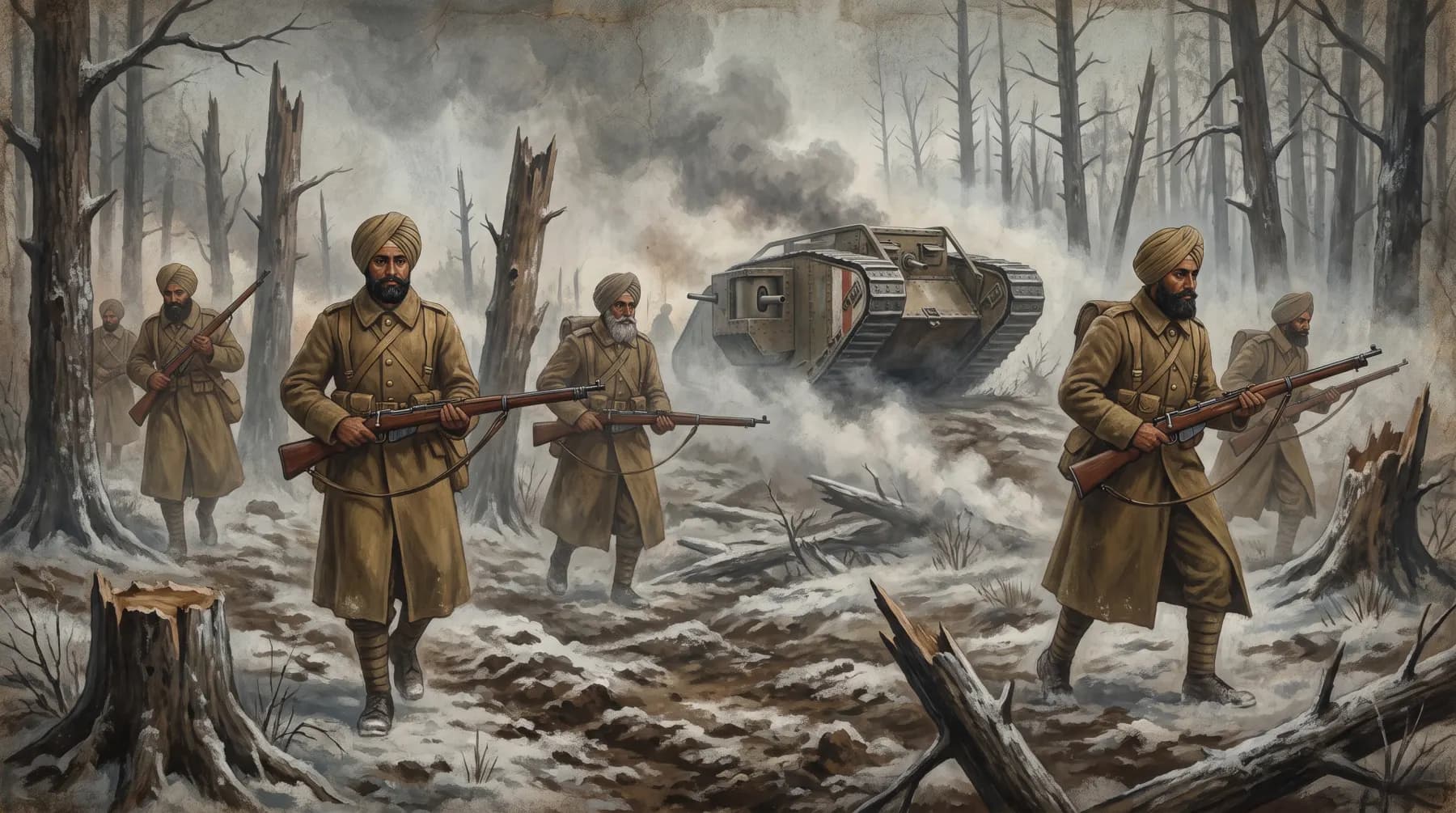
Painted reconstruction: dismounted Indian cavalrymen in turbans and khaki greatcoats advance on foot through a shattered winter wood, a tank dimly visible ahead through smoke.
Gauche Wood, 1 December 1917. Indian cavalry fought this action dismounted, advancing behind tanks after a Canadian horse-artillery barrage.Artistic historical reconstruction

1 December — Gauche Wood and Villers-Guislain

On 1 December, Indian cavalry was heavily engaged in the struggle to stop the German counter-offensive. Tanks co-operated with dismounted Indian cavalry of the 5th Cavalry Division and with Guards troops in the attacks on Villers-Guislain and Gauche Wood. Gauche Wood was captured after severe fighting; smashed German machine guns and captured field guns were found in the position.

The 18th King George's Own Lancers fought dismounted around Gauche Wood. Their attack was to follow eight tanks after a 15-minute barrage from a Canadian horse-artillery battery. D Squadron first occupied an exposed crest, where roughly half of a 25-man party became casualties and three Hotchkiss guns were put out of action. When the tanks arrived, B Squadron advanced behind them, entered Gauche Wood, captured prisoners and found a complete German howitzer battery with ammunition. Indian cavalrymen then held the wood mixed with Grenadier Guards under prolonged shellfire.

Elsewhere, 2nd Lancers (Gardner's Horse) of the 4th Cavalry Division carried out one of the battle's most dramatic mounted actions. At about 9:35 a.m. they charged toward German positions around Gauche Wood and Villers-Guislain, followed by a squadron of the 6th Inniskilling Dragoons. The action achieved local results but cost the 2nd Lancers more than 100 casualties, including the commanding officer, Lieutenant-Colonel Turner.

“Machine-gun fire fell like a rain storm.”
Jemadar Jiwan Singh, 2nd Lancers (Gardner's Horse), recalling the charge of 1 December 1917The Western Front Association, “The Indian Cavalry at Cambrai”

06 — SIDE BY SIDE

Indian and Canadian soldiers in one division

Cambrai offers stronger evidence of direct Indian–Canadian cooperation than any other Western Front battle on this site.

Cambrai provides stronger evidence of direct Indian–Canadian cooperation than many earlier Western Front battles, because Indian and Canadian cavalry were integrated at divisional level.

The 5th Cavalry Division contained the Secunderabad Brigade and the Ambala Brigade, both built around major Indian Army regiments, alongside the Canadian Cavalry Brigade. They shared the same divisional commander, the same operational plan, the same routes of exploitation, and later the same defensive responsibilities.

What the records actually show

  • Shared divisional command. The Indian and Canadian brigades belonged to the same 5th Cavalry Division and operated under one divisional plan.
  • A shared mission on 20 November. Both were to exploit the breach and help isolate Cambrai.
  • Direct Canadian fire support to an Indian regiment. At Gauche Wood on 1 December a Canadian horse-artillery battery fired a 15-minute 13-pounder barrage for the Indian 18th Lancers before their dismounted advance.
  • Adjacent defensive work. After 30 November the division was increasingly used on foot to reinforce a threatened front rather than for a sweeping mounted breakthrough.
  • Remembered comradeship. Regimental tradition preserved the connection after the war through exchanges of ceremonial silver between Indian and Canadian cavalry regiments.

The 18th Lancers' recorded comradeship with the Fort Garry Horse and the Royal Canadian Dragoons, including that exchange of commemorative silver, gives tangible evidence that Indian and Canadian soldiers did more than fight in the same campaign. They remembered themselves as battlefield comrades.

07 — HONOURS

Heroism and decorations

Two Victoria Crosses — one Indian, one Canadian — and the awards, acts and accounts recorded around them.

Indian Army

Lance-Dafadar Gobind Singh

28th Light Cavalry, attached to 2nd Lancers (Gardner's Horse)

Victoria Cross1 December 1917, east of Peizières

Volunteered three times to carry urgent messages between regiment and brigade headquarters across about a mile and a half of open ground under heavy fire. Each horse was killed or disabled; he completed the journeys on foot.

2nd Lancers (Gardner's Horse)

Mhow Cavalry Brigade, 4th Cavalry Division

Battle honour: Cambrai1 December 1917

Charged German positions around Gauche Wood and Villers-Guislain at 9:35 a.m. More than 100 casualties, including the commanding officer — the regiment's heaviest losses of the war — yet the attack continued through heavy machine-gun fire.

18th King George's Own Lancers

Ambala Cavalry Brigade

Battle honour: Cambrai1 December 1917

Fought dismounted at Gauche Wood. After waiting for tanks, B Squadron advanced into the wood, took prisoners and captured a complete German howitzer battery, then held the position intermixed with Grenadier Guards under prolonged bombardment. Guards officers praised the Lancers' dash and fighting spirit.

38th King George's Own Central India Horse

Mhow Cavalry Brigade

Battle honour: Cambrai

Committed during the counter-attack phase under severe machine-gun fire. Brigade and war-diary accounts praised the spirit and conduct of all ranks as they continued toward their objective despite the expected tank support failing to arrive as planned.

Captain Som Dutt

Indian Medical Service, Regimental Medical Officer with 9th Hodson's Horse

Military Cross

Already held; not confirmed as awarded for this specific act.

Regimental histories record that during the severe Cambrai fighting he treated a badly wounded German officer under fire. The officer was so moved that he presented Som Dutt with his Iron Cross.

Sowar Dalawar Chand

18th King George's Own Lancers

Eyewitness account

No individual Cambrai medal confirmed in the consulted sources.

Left an Indian eyewitness account describing the regiment advancing under artillery and low-flying aircraft fire and taking German prisoners. His account records a German prisoner carrying the wounded Dafadar Falk Sher Khan toward medical aid.

Canadian — Fort Garry Horse

Lieutenant Harcus Strachan

Fort Garry Horse

Victoria Cross20 November 1917, beyond Masnières

Took command of B Squadron after its commander was killed; led the squadron through machine-gun posts, charged and silenced a German field battery, cut rear telephone communications, then fought back through the German lines with his surviving men and fifteen prisoners.

Lieutenant William Joseph Cowen

Fort Garry Horse

Military Cross

Second-in-command in the deep cavalry penetration. Although badly wounded, he continued leading and brought prisoners back during the withdrawal.

Lieutenant Edward William Fleming

Fort Garry Horse

Military Cross

Awarded for conduct in the Cambrai action as recorded by the Fort Garry Horse regimental museum.

Captain Ernest Coulter Whitehouse

Canadian Army Medical Corps, attached Fort Garry Horse

Military Cross

Repeatedly attended and brought in wounded under heavy fire.

Sergeant James Bernas

Fort Garry Horse

Distinguished Conduct Medal

After his horse was shot during the squadron penetration, gathered dismounted men and held their position against attacks until after dark, then rejoined the squadron.

Trooper William Albert Morrall

Fort Garry Horse

Distinguished Conduct Medal

Volunteered to carry messages after the squadron became cut off. His first horse was shot; he delivered the message on foot, volunteered to return, lost another horse and was wounded while trying to continue.

A/Sgt T. P. Tebburt; Troopers J. E. van Wilderode, T. Gibbons and W. Hall

Fort Garry Horse

Military Medal

Regimental records list these Military Medals for conduct associated with the Cambrai action.

Cpl J. McKay and L/Cpl F. Fitzgerald

Fort Garry Horse

Bar to the Military Medal

Bars to Military Medals previously earned, for further gallantry recorded by the regiment during the Cambrai period.

08 — THE COST

Casualties

Roughly 89,000 casualties on both sides combined — and an Indian total that the sources will not fully settle.

Casualty totals vary slightly with the date range used. The best museum-level estimate places total British Empire and Allied losses at about 44,000 killed, wounded or captured, against roughly 45,000 German casualties. Indian cavalry losses are inside the British total and must not be added to it again.

Force or unitCasualtiesNotes
All Allied / British Empire forcesabout 44,000National Army Museum total for the British Cambrai operations. Includes British, Indian, Canadian, Newfoundland and other Empire troops.
German Armyabout 45,000National Army Museum estimate. Combined losses for both sides were therefore roughly 89,000.
Indian cavalry — documented minimummore than 197NOT a complete Indian total. Combines only 2nd Lancers (>100), 9th Hodson's Horse (58) and 18th Lancers (39).
2nd Lancers (Gardner's Horse)more than 100Cambrai was the regiment's heaviest loss of the war; Lt-Col Turner was among the dead.
9th Hodson's Horse5810 killed, 48 wounded, in the severe 30 Nov – 1 Dec fighting.
18th King George's Own Lancers39For 1–8 December: 1 officer and 6 men killed; 3 British officers, 1 Indian officer and 28 others wounded, three of whom later died.
Fort Garry Horse, 20–21 Nov827 killed, 21 wounded, 54 wounded or missing. Also about 140 horses killed, wounded or missing.
Canadian Cavalry Brigade overallnot publishedCanadian government sources confirm the three battle-honour regiments but publish no single brigade casualty total.

Indian and Canadian figures are subsets of the British Empire total and should not be added to it again.

09 — LEGACY

Outcome and what Cambrai changed

Neither a British nor a German victory — but a battle where both armies learned the methods that shaped 1918.

The outcome

The opening attack was a genuine British tactical success. Surprise was achieved, sections of the Hindenburg Line were penetrated rapidly, thousands of German prisoners were taken, and the British advanced farther in a single day than during many previous offensives. Canadian cavalry briefly penetrated beyond the canal and demonstrated what exploitation might look like if a breach could be opened and kept open.

The broader operational objective was not achieved. The cavalry could not pass through in sufficient strength, Cambrai was not isolated or captured, and Bourlon Wood became a costly struggle. German reserves arrived faster than the British could exploit the breakthrough. On 30 November the German counter-offensive recovered substantial ground and forced the British to abandon exposed portions of the salient.

The final result is best described as a costly tactical experiment that produced an initial breakthrough but no decisive operational victory.

What it meant for the Indian Army

For the Indian cavalry, Cambrai was one of the most important Western Front battles of the war, because it demonstrated adaptability rather than obsolescence. Indian regiments were given genuine operational objectives: first to exploit the Hindenburg Line breakthrough and help isolate Cambrai, then to stop the German counter-offensive around Épehy, Gauche Wood and Villers-Guislain. They fought mounted when a tactical opening appeared, dismounted when the line had to be held, and in close cooperation with tanks, machine guns, horse artillery and British infantry.

Gobind Singh's Victoria Cross, the 2nd Lancers' costly charge, 9th Hodson's Horse holding the threatened line, and the 18th Lancers' entry into Gauche Wood all demonstrate significant Indian achievement. The broader cavalry encirclement was never completed, but during the counter-offensive phase Indian formations accomplished important local defensive and counter-attack objectives and helped prevent a deeper German exploitation.

What it meant for Canada

Canada's main field army was not committed at Cambrai, but the Canadian Cavalry Brigade had a clearly defined role in the Cavalry Corps plan: pass through the Masnières sector, help isolate Cambrai, secure the Sensée crossings and disrupt German movement behind the Hindenburg Line. Fort Garry Horse came closest to realising that objective when B Squadron crossed at Masnières and penetrated beyond the supporting infantry before being isolated.

The battle also reinforced the distinctive role of Canadian mounted troops outside the Canadian Corps. Their service within the 5th Cavalry Division placed them directly beside Indian cavalry regiments and made Cambrai one of the clearest examples of Canadian and Indian formations serving under the same divisional command on the Western Front.

Why Cambrai mattered to the war

  • Massed tanks proved that a heavily fortified trench system could be penetrated quickly without days of preliminary bombardment.
  • Predicted artillery fire and “silent registration” showed how guns could achieve surprise while still delivering accurate fire from the opening minute.
  • Tank–infantry cooperation, air support, engineers and cavalry were combined on an unprecedented scale, foreshadowing the mature all-arms offensives of 1918.
  • The battle exposed the limits of technology without reserves, communications and logistics. A breakthrough could be created, but it still had to be reinforced, supplied and widened rapidly.
  • The German counter-offensive demonstrated infiltration tactics, short bombardments, gas and decentralised assault methods that would be used on a far larger scale in the Spring Offensive of 1918.

Overall assessment

Cambrai was neither a simple British victory nor a simple German one. The British proved they could rupture the Hindenburg Line by surprise and combined arms; the Germans proved they could recover from the shock and launch a sophisticated counterstroke. The operation ended without the capture of Cambrai and with only a portion of the original British gains retained.

For the Indian and Canadian story, the battle has unusual significance. The heroism of Gobind Singh and Harcus Strachan captures the two sides of the cavalry experience: an Indian cavalryman repeatedly crossing open ground to preserve communications during a crisis, and a Canadian officer leading a mounted penetration deep into the enemy rear. Both actions occurred in a battle where the newest weapon of the war fought alongside one of its oldest arms.

SOURCES

Where this comes from

Every claim in this study is drawn from the works below. Where they disagree or fall silent, the text says so rather than choosing for them.

  1. 01Cambrai, 1917 — battle honourDepartment of National Defence, Canada
  2. 02Harcus Strachan — Victoria Cross recipientsDepartment of National Defence, Canada
  3. 03Guide to Sources Relating to Units of the CEF: CavalryLibrary and Archives Canada
  4. 041917: Year of Stalemate — Cambrai and casualty totalsNational Army Museum
  5. 05The 2nd Ride of Lance Dafadar (later Jemadar) Gobind Singh VCNational Army Museum
  6. 06The Indian Cavalry at CambraiThe Western Front Association (David Tattersfield, 2020)
  7. 07The Battle of Cambrai — Why Did It Succeed and What Went Wrong?The Western Front Association
  8. 08The Cambrai Operations, 1917The Long, Long Trail
  9. 092nd Indian Cavalry Division (later 5th Cavalry Division)The Long, Long Trail
  10. 10Fifth Despatch: Battle of Cambrai, 1917Sir Douglas Haig, via The Long, Long Trail
  11. 111914–1919 and Awards and DecorationsFort Garry Horse Museum & Archives
  12. 12France and Flanders — Indian Army Victoria Cross and battle-honour recordMinistry of External Affairs, Government of India
  13. 13Indian Army remembers 1917 battle on Cambrai DayTimes of India (1 Dec 2014)
  14. 14Official History of the Canadian Army in the First World WarDepartment of National Defence, Canada
  15. 15The Canadian Cavalry Brigade at CambraiCanadian Army Journal, Vol. 8 No. 4 (Winter 2005)
  16. 162nd Lancers (Gardner's Horse) — regimental history and war diariesResearching WW1 Soldiers
  17. 179th Hodson's Horse — regimental history and war diariesResearching WW1 Soldiers