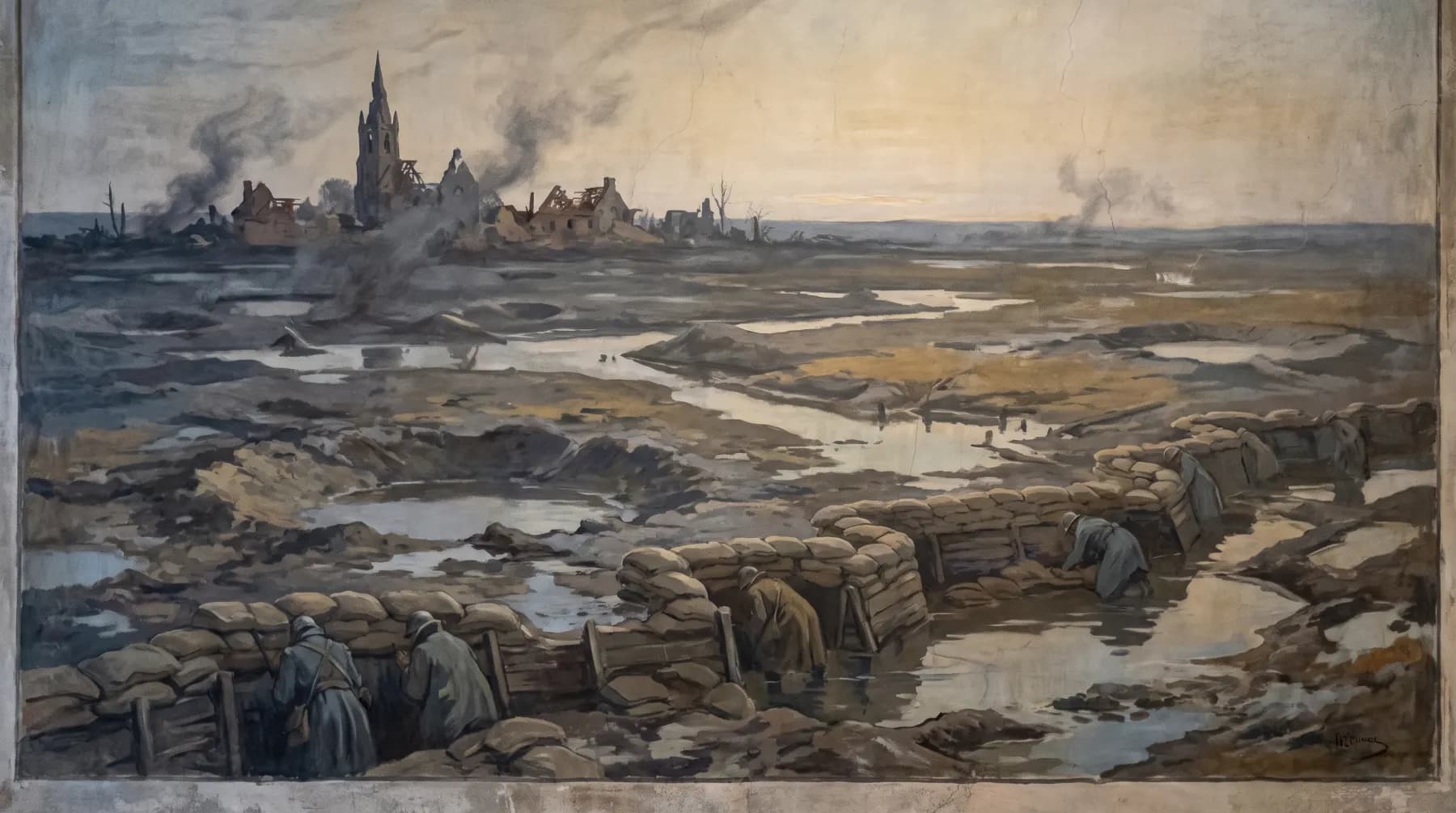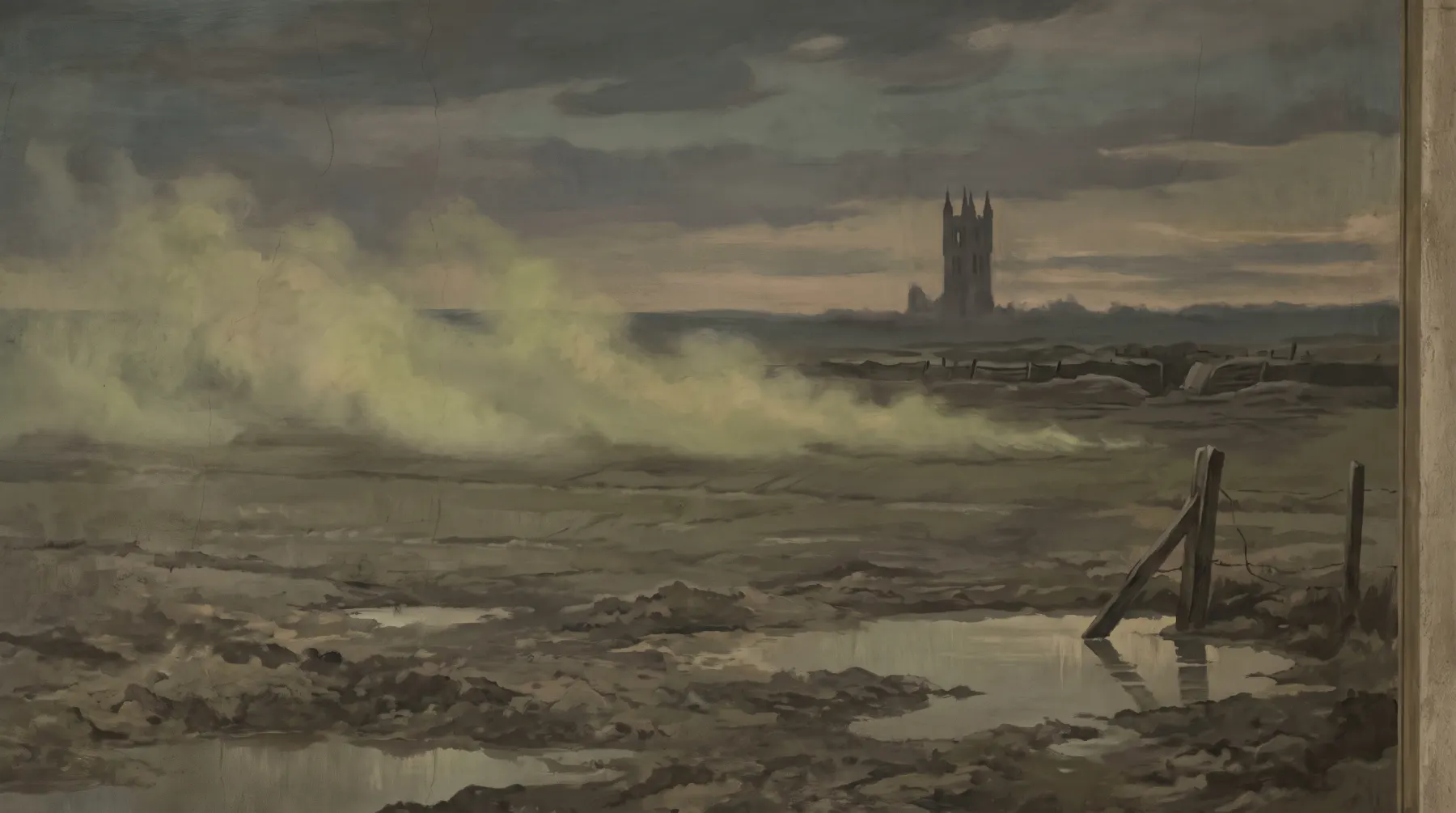
Painted reconstruction of a pale yellow-green chlorine gas cloud drifting across flat Flanders farmland at dusk, with the ruined tower of the Ypres Cloth Hall silhouetted on the horizon.

22 April – 25 May 1915

The Second Battle of Ypres

Gas, the Canadian stand, and the Lahore Division's costliest day

The first large-scale use of chlorine gas on the Western Front. The 1st Canadian Division held the gap it tore open; the 3rd (Lahore) Division was rushed north and attacked toward Mauser Ridge, losing 3,889 men in eight days.

Artistic historical reconstruction

Dates
22 Apr – 25 May 1915
Where
Ypres Salient, Belgium
Indian formation
3rd (Lahore) Division
Canadian formation
1st Canadian Division
Lahore Division losses
3,889 — about 30%
Victoria Crosses
Mir Dast and four Canadians

Why this battle is here

Second Ypres is where the Canadian and Indian stories first meet at scale — Canadians containing the breach, Indian troops counter-attacking it, and Canadian guns firing for the Indian advance of 27 April.

01 — OVERVIEW

Four battles under one name

Second Ypres was not one continuous assault. Official nomenclature divides it into four battles, and the Canadian and Indian stories sit in the first two.

The Second Battle of Ypres began on 22 April 1915 when the German Fourth Army attacked the northern and eastern faces of the Ypres Salient. It was the first large-scale use of chlorine gas on the Western Front. The gas struck the French 45th (Algerian) and 87th (Territorial) Divisions north of the 1st Canadian Division, causing severe disorganisation and opening a gap several miles wide.

The 1st Canadian Division fought to keep that gap from being exploited and to protect the approaches to Ypres. As Allied reserves became dangerously scarce, the 3rd (Lahore) Division of the Indian Army was rushed north from rest. The Lahore troops moved through Boeschepe and Ouderdom toward Wieltje after exhausting forced marches, entering a battlefield already filled with shellfire, gas casualties and retreating wounded.

The four recognised battles

BattleDatesWhat happened
Gravenstafel Ridge22–23 AprilGermany released chlorine against French and North African troops north of the Canadians. The French line broke in places, exposing the Canadian left flank. Canadian counter-attacks, including Kitchener's Wood, helped prevent the opening from becoming a decisive breakthrough.
St. Julien24 April – 4 MayA second gas attack struck the Canadian front on 24 April, especially the 8th and 15th Battalions. During this phase the Lahore Division was rushed to Wieltje and attacked toward Mauser Ridge on 26–27 April and again on 1 May. This was the main Indian phase of the battle.
Frezenberg Ridge8–13 MaySix German divisions attacked the British 27th and 28th Divisions. Princess Patricia's Canadian Light Infantry, serving in the British 27th Division, held its exposed flank on 8 May despite nearly 400 casualties.
Bellewaarde Ridge24–25 MayThe final recognised phase. German forces renewed attacks, including gas, around Bellewaarde. The salient had been compressed and much ground lost, but Ypres remained in Allied hands.

How Canadians and Indians related here

The Canadian and Indian forces generally did not make the same battalion-level assault together. Their cooperation was operational: Canadians contained the initial breakthrough, and the Lahore Division was then committed to counter-attack the new German positions.

A particularly direct connection occurred on 27 April, when Canadian artillery supported the renewed French and Lahore Division attack.

02 — OBJECTIVES

What each side was trying to achieve

A German attempt to rupture the salient with a new weapon, a Canadian fight to contain it, and an Indian order to attack 1,500 yards of open ground.

  • German objective: rupture the Allied line north of Ypres by combining artillery, infantry and chlorine gas; seize better ground around the salient; and force the Allies onto a shorter line while German strategic attention was increasingly concentrated on the Eastern Front.
  • Canadian objective: close or contain the gap created by the French collapse, prevent German troops from turning the Canadian flank, hold the approaches to Ypres, and delay the offensive long enough for British and Imperial reinforcements to arrive.
  • Indian objective: the 3rd (Lahore) Division was ordered to attack from the Wieltje–La Brique area toward the German trenches on Mauser Ridge, roughly 1,500 yards away, to regain ground and relieve pressure on the salient in conjunction with French troops on the Indian left.

What the Lahore Division's order actually required

  • Cross Hill Top Ridge and the exposed ground beyond it.
  • Cross the stream and climb the open slope toward Mauser Ridge.
  • Break into the German trench system despite limited artillery preparation, incomplete reconnaissance and uncut wire.
  • Coordinate with the French attack on the left — and when the French failed to advance as planned, the Lahore Division became more exposed.

03 — THE GROUND

A salient overlooked from three sides

Why the terrain around Wieltje and Mauser Ridge made the Indian attack of 26 April so costly.

  • The Ypres Salient: an Allied bulge projecting into German-held territory, allowing German artillery to fire into it from multiple directions and from higher ground.
  • Wieltje and La Brique: the principal Lahore Division deployment area for the 26 April counter-attack.
  • Hill Top Ridge: concealed the first part of the Indian advance — but crossing its crest exposed the troops to German observation and machine-gun fire.
  • The stream and open slope: after the ridge, the Indians had to cross a low area and a stream, then climb roughly 600 yards of open ground toward the German trenches.
  • Mauser Ridge: strong German defensive ground protected by trenches, machine guns, artillery and wire. The main Indian objective.
  • Hedges and ditches: natural cover was dangerous, because German artillery had registered likely shelter points in advance.
  • Roads and marches: the Lahore Division reached the battlefield after long forced marches over wet pavé roads, increasing exhaustion before the assault even began.
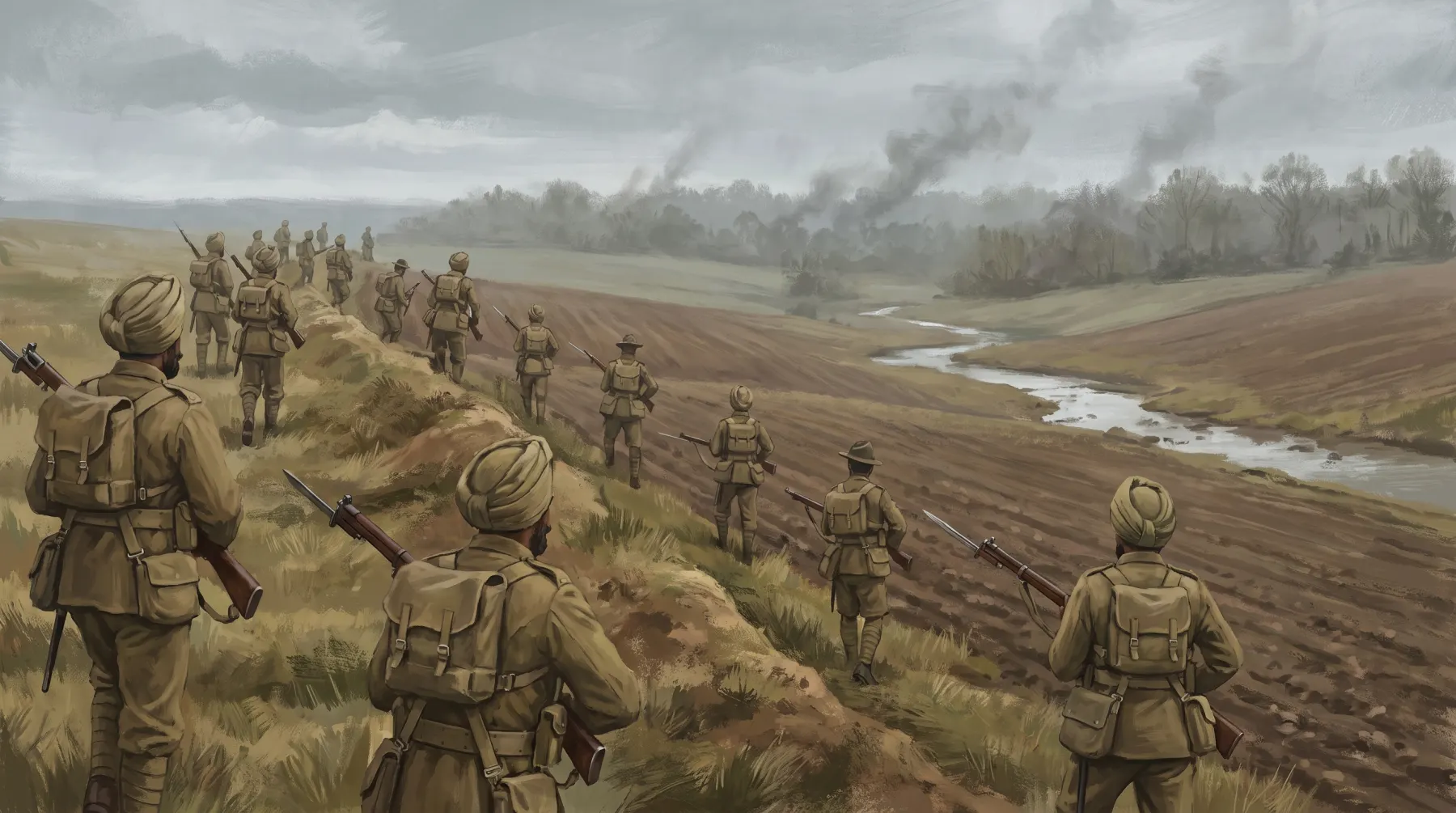
Painted reconstruction of Indian Lahore Division soldiers in turbans and khaki cresting a low ridge and descending an exposed open slope toward a distant tree line under an overcast sky.
The ground the Lahore Division had to cross on 26 April 1915: over the crest of Hill Top Ridge, down to a stream, then up roughly 600 yards of open slope toward Mauser Ridge.Artistic historical reconstruction

04 — WHO FOUGHT

Order of battle

The 3rd (Lahore) Division's three brigades, the 1st Canadian Division's three brigades, and the French and German formations around them.

Formations

Indian Army

Ferozepore Brigade — 3rd (Lahore) Division

Left assault formation on 26 April.

  • 1st Battalion, Connaught RangersBritish battalion within the brigade
  • 57th (Wilde's) Rifles (Frontier Force)
  • 129th Duke of Connaught's Own Baluchis
  • 1/4th Battalion, London Regiment
  • 9th Bhopal Infantry

Indian Army

Jullundur Brigade — 3rd (Lahore) Division

Right assault formation on 26 April.

  • 47th SikhsLost 348 of 444 men committed — about 78 per cent
  • 40th Pathans
  • 1st Battalion, Manchester Regiment
  • 4th Battalion, Suffolk Regiment
  • 59th Scinde Rifles (Frontier Force)

Indian Army

Sirhind Brigade — 3rd (Lahore) Division

In reserve on 26 April; led the renewed attack from 27 April.

  • 1st Battalion, Highland Light Infantry
  • 4th Battalion, King's (Liverpool) Regiment
  • 15th Ludhiana Sikhs
  • 1/1st Gurkha Rifles
  • 1/4th Gurkha Rifles

Indian Army

Engineer and pioneer support

  • 3rd Sappers and Miners
  • 34th Sikh PioneersRestored communications under fire on the night of 26–27 April

Canadian

1st Canadian Infantry Brigade

  • 1st Canadian Infantry Battalion
  • 2nd Canadian Infantry Battalion
  • 3rd Canadian Infantry Battalion
  • 4th Canadian Infantry Battalion

Canadian

2nd Canadian Infantry Brigade

Brigadier-General Arthur W. Currie

  • 5th Canadian Infantry Battalion
  • 7th Canadian Infantry BattalionHeavy fighting near Keerselaere; Bellew VC
  • 8th Canadian Infantry BattalionAmong the battalions hit hardest by the 24 April gas attack; Hall VC
  • 10th Canadian Infantry BattalionKitchener's Wood counter-attack with the 16th

Canadian

3rd Canadian Infantry Brigade

Brigadier-General R. E. W. Turner, VC

  • 13th Canadian Infantry Battalion (Royal Highlanders of Canada)Fisher VC
  • 14th Canadian Infantry Battalion (Royal Montreal Regiment)Scrimger served as medical officer
  • 15th Canadian Infantry Battalion (48th Highlanders)Among the battalions hit hardest by the 24 April gas attack
  • 16th Canadian Infantry Battalion (Canadian Scottish)Kitchener's Wood counter-attack with the 10th

Canadian

Canadian artillery and additional formations

  • Canadian divisional artilleryRemained active after the infantry was relieved; specifically recorded supporting the French–Indian attack of 27 April
  • Princess Patricia's Canadian Light InfantryServed in the British 27th Division, 80th Brigade, during the Frezenberg fighting

French

French forces

  • 45th (Algerian) DivisionHeld the sector immediately to the Canadian left when the first chlorine attack struck
  • 87th (Territorial) DivisionHeld the adjacent northern French sector

German

German Fourth Army

Principal German army conducting the Ypres offensive.

  • German reserve corps and divisionsAttacked across the northern and eastern faces of the salient
  • Defenders on Mauser RidgePrepared trenches, machine guns, artillery, barbed wire, registered defensive fire and repeated use of gas

05 — WHAT HAPPENED

From the first gas cloud to Frezenberg

The Canadian stand, the Lahore Division's forced march and attack, the night of rescue, and the PPCLI at Frezenberg.

22–25 April — Canadians hold the breach

The first chlorine cloud broke much of the French front and exposed the Canadian left. Canadian troops rapidly shifted positions and counter-attacked. The 10th and 16th Battalions made the night attack at Kitchener's Wood, while the rest of the division fought to construct a new defensive line around Gravenstafel and St. Julien.

On 24 April chlorine was released directly against the Canadians, falling most heavily on the 8th and 15th Battalions at the junction of the 2nd and 3rd Brigades. The division was forced back but prevented the Germans from turning the rupture into a decisive breakthrough.

23–26 April — the Lahore Division is rushed to the salient

The Lahore Division was warned to move on 23 April. It undertook long marches over steep, slippery pavé roads and reached the Ypres area already exhausted. From Mont des Cats the troops could see the bombardment around Ypres. During the final approach to Wieltje they passed wounded men moving to the rear, including soldiers blinded and coughing from gas. The 40th Pathans suffered about 23 casualties from a single shell before the main assault even began.

26 April — the attack toward Mauser Ridge

By late morning the Lahore Division deployed between the Ypres–Langemarck road and Wieltje. The Ferozepore Brigade formed the left assault formation, the Jullundur Brigade the right, and the Sirhind Brigade remained in reserve. The German trenches were roughly 1,500 yards away beyond Hill Top Ridge.

After a short and inadequate bombardment the attack began shortly after 2 p.m. The first part of the advance was partly screened by Hill Top Ridge, but once the infantry crossed the crest it had to descend in full view of German machine guns and artillery, cross a small stream, then climb an exposed slope toward the German line. Reconnaissance was poor, the exact trench position uncertain, and the artillery too light to destroy the defences.

The 40th Pathans, 47th Sikhs, 57th Wilde's Rifles, 129th Baluchis, Connaught Rangers and 1st Manchesters suffered devastating losses. The 47th Sikhs lost 348 of the 444 men committed — about 78 per cent. Across the two assault brigades, losses approached 2,000 in the day's fighting. The Germans later released more chlorine, intensifying the confusion and forcing much of the attacking force back.

Night of 26–27 April — holding, rescue and reorganisation

Some troops remained dangerously far forward. Major Deacon's Connaught Rangers held an exposed position near the German line. Jemadar Mir Dast, attached to the 57th Wilde's Rifles, rallied scattered and gassed survivors after the officers around him had been killed or wounded, held them until withdrawal was ordered, and repeatedly helped carry wounded British and Indian officers to safety.

The Sirhind Brigade moved forward to relieve exhausted troops, while the 3rd Sappers and Miners and 34th Sikh Pioneers helped consolidate communications and the line.

27 April – 1 May — the Sirhind Brigade attacks

The 1/1st and 1/4th Gurkha Rifles led the renewed Sirhind Brigade attack, supported by the 4th King's (Liverpool), 1st Highland Light Infantry and 15th Ludhiana Sikhs, with the Ferozepore remnants attacking on the right. Canadian artillery supported the French and Indian advance on 27 April. The attack again ran into machine-gun fire, artillery and intact barbed wire. Elements of the 4th King's advanced to within roughly 200 yards of the German position, but the wire and defensive fire made further progress impossible.

Further attacks were reduced or cancelled. The Jullundur and Ferozepore Brigades withdrew during the night of 29–30 April. On 1 May the Sirhind Brigade made one final attempt, but the Germans remained entrenched and the French were unable to make the required progress on the left. The brigade was ordered to collect the wounded, bury the dead and withdraw. The Lahore Division had lost 3,889 men from 24 April to 1 May — about 30 per cent of the force deployed.

8–13 May — Frezenberg and the PPCLI

After the front was shortened, the German attack shifted to the new British positions. On 8 May six German divisions attacked the British 27th and 28th Divisions. Princess Patricia's Canadian Light Infantry held the exposed left flank of the 27th Division near Bellewaarde Ridge. Its machine-gun positions were badly hit, and every available man — including signallers, batmen and orderlies — was used in the defence. The PPCLI suffered almost 400 casualties that day; when finally relieved, it was reduced to four officers and about 150 men.

06 — HONOURS

Heroism and decorations

Mir Dast's Victoria Cross, four Canadian VCs, and the Indian awards and acts recorded alongside them.

Indian Army

Jemadar Mir Dast

55th (Coke's) Rifles, attached to 57th (Wilde's) Rifles

Victoria Cross26 April 1915, Ypres / Wieltje sector

Rallied scattered survivors after the officers around him had been killed or wounded, kept them under command until retirement was ordered, and helped carry eight wounded British and Indian officers to safety while exposed to heavy fire. He was himself wounded.

Sepoy Raji Khan

129th Baluchis

Indian Order of Merit26 April 1915, Mauser Ridge

Carried an urgent message through heavy rifle and shell fire. A shell burst only a few yards away and wounded him, but he continued until the message was delivered.

Sapper Jai Singh

34th Sikh Pioneers

Indian Distinguished Service MedalNight of 26–27 April 1915

Helped restore and maintain lines of communication under constant enemy fire while the Lahore Division attempted to consolidate its precarious forward position.

Sapper Gujar Singh

34th Sikh Pioneers

Indian Distinguished Service MedalNight of 26–27 April 1915

Worked with Jai Singh to restore communications under fire.

Naik Ayub Khan

124th Baluch Infantry, attached to 129th Baluchis

Recommended for the Indian Distinguished Service Medal26 April 1915

The source reviewed does not establish the final award.

Listed among men recommended for the IDSM for bravery during the attack.

Mula Singh and Rur Singh

47th Sikhs

Recorded act of courage26 April 1915

No medal specified in the sources reviewed.

Repeatedly helped rescue wounded men under heavy fire during the catastrophic 47th Sikhs assault, in which the battalion lost about 78 per cent of those committed.

Bhan Singh

57th Wilde's Rifles

Recorded act of courage26 April 1915

No medal specified in the sources reviewed.

Although wounded in the face, remained near Captain Banks and tried to carry the officer's body back under fire; when exhausted, he still saved the officer's personal belongings before withdrawing.

Corporal Issy Smith

1st Manchester Regiment, Jullundur Brigade

Victoria Cross26 April 1915

Repeatedly evacuated wounded men under heavy fire during the 26 April attack. Included here because it shows that the Lahore Division's bravery was shared across its Indian and British battalions.

Canadian Victoria Crosses

Lance-Corporal Frederick Fisher

13th Battalion, CEF

Victoria Cross (posthumous)23 April 1915, near St. Julien

Brought a Colt machine gun forward under heavy fire to protect two Canadian 18-pounder guns in danger of being overrun. After losing four members of his crew he returned with replacements and continued firing to cover the battery's withdrawal. He was killed the following day while again bringing the gun into action.

Company Sergeant-Major Frederick William Hall

8th Battalion, CEF

Victoria Cross (posthumous)24 April 1915, near Ypres

A wounded soldier lay about fifteen yards outside the trench calling for help. Hall first tried to reach him with two other men, who were wounded. He then went out alone under heavy enfilade fire and was mortally wounded while attempting to lift the casualty.

Lieutenant Edward Donald Bellew

7th Battalion, CEF

Victoria Cross24 April 1915, near Keerselaere

As battalion machine-gun officer he kept two guns in action while the German assault approached to less than 100 metres. His sergeant was killed and Bellew was wounded, but he continued until the ammunition was exhausted, then smashed his machine gun before capture so it could not be used by the enemy.

Captain Francis Alexander Carron Scrimger

Canadian Army Medical Corps; medical officer, 14th Battalion

Victoria Cross25 April 1915, near Ypres

Directed the evacuation of wounded from an advanced dressing station under heavy shellfire. He personally carried a severely wounded officer from a stable and, unable to move him farther alone, remained beside him under fire until help arrived. His citation also recognised continuous devotion to the wounded from 22–25 April.

07 — THE COST

Casualties

Nearly 70,000 Allied casualties across the battle — including 3,889 from the Lahore Division in eight days.

Figures vary by source because historians use slightly different date ranges and accounting systems. Canadian and Lahore Division figures are subsets of the British Empire and Allied totals and should not be added to them again.

All sides

Side or formationEstimated casualtiesNotes
British Empire — whole battlemore than 55,000Imperial War Museums gives more than 55,000; the traditional British official-history figure is 59,275.
Canadian forces — opening phase6,035Veterans Affairs Canada records 6,035 in the crucial 48-hour period, more than 2,000 of them dead.
3rd (Lahore) Division3,889Killed, wounded or missing from 24 April to 1 May — approximately 30 per cent of the division's deployed strength.
French forcesuncertainTraditional estimates give about 18,000 on 22 April plus further losses. French losses are the least certain; later historians have questioned some first-day figures.
German forcesabout 35,000National Army Museum. Postwar German official records cited by historians give about 34,933 for 21 April – 30 May.
Allied forces — combinednearly 70,000National Army Museum figure across the whole battle.

Lahore Division units — roles and losses

UnitBrigadeRoleCasualties
57th Wilde's RiflesFerozeporeCentre of the first assault line, 26 Apr; Mir Dast attached275
129th BaluchisFerozeporeRight of the first assault line; Raji Khan's action231
Connaught RangersFerozeporeLeft of the first assault line; Major Deacon's group held forward overnight376
47th SikhsJullundurFirst-line assault toward Mauser Ridge348 of 444 — about 78%
40th PathansJullundurMajor 26 Apr assault; A Company advanced rapidly320
1st ManchestersJullundurAssault line; Issy Smith VC rescue actions289
1/1st Gurkha RiflesSirhindMain attack 27 Apr; renewed effort 1 MayHeavy; exact total not stated
1/4th Gurkha RiflesSirhindMain attack 27 Apr; reached a farm before being heldHeavy; exact total not stated
15th Ludhiana SikhsSirhindSupport on 27 Apr; exposed to crossfireHeavy; exact total not stated
4th King's (Liverpool)SirhindAdvanced by short rushes to about 200 yards from the German line374 other ranks
3rd Sappers and MinersDivisionalConsolidated the front after the first attackNot specified
34th Sikh PioneersDivisionalCommunications and consolidation; two IDSMsNot specified

Where a regimental total was not located in the accessible sources, this table says so rather than estimating.

08 — LEGACY

Outcome and long-term significance

Ypres held. Chemical warfare became permanent. And the battle entered Canadian and Indian memory in very different ways.

The outcome

Germany gained substantial ground and forced the Allies to compress the Ypres Salient, but the German Fourth Army did not capture Ypres or destroy the Allied position. The offensive demonstrated that poison gas could rupture an unprepared line, but it also showed that a breakthrough still required reserves, artillery and coordination to exploit the opening. By the end of the battle the Allies held a smaller and more exposed salient around Ypres.

Impact on the Canadian forces

Second Ypres was the 1st Canadian Division's first major battle. Its resistance at Gravenstafel and St. Julien prevented the gas-created gap from becoming a strategic collapse. The division suffered about 6,000 casualties in only a few days. The actions of Fisher, Hall, Bellew and Scrimger produced four Victoria Crosses and helped establish a Canadian reputation for determination under extreme conditions. The later PPCLI defence at Frezenberg reinforced that reputation at enormous cost.

Impact on the Indian Army

For the Lahore Division, Second Ypres was an important operational contribution to the Allied defence of the salient. The division was rushed forward at a critical moment, helped contain the German advance, maintained pressure on the new German positions, and then helped consolidate and stabilise the Allied front. Its soldiers did this despite inadequate reconnaissance and artillery preparation, terrain dominated by German machine guns, poison gas, and intact wire.

The division did not achieve its immediate tactical objective of taking the German positions on Mauser Ridge, but its attacks and subsequent consolidation work contributed to preventing a wider German breakthrough and keeping Ypres in Allied hands. The cost was severe: 3,889 casualties, roughly 30 per cent of the troops deployed, while the 47th Sikhs alone lost about 78 per cent of the men committed on 26 April.

The battle also produced some of the clearest examples of comradeship inside the Indian Army: Mir Dast carried both British and Indian officers to safety; Sikh soldiers rescued wounded comrades under fire; Indian pioneers restored communications; and British battalions embedded within the Lahore brigades suffered alongside their Indian counterparts.

Long-term significance

  • Chemical warfare became a permanent feature of the Western Front after the German gas attacks at Ypres.
  • The battle exposed the danger of attacking prepared machine-gun positions without enough heavy artillery, accurate reconnaissance or cut wire.
  • Canadian experience at Ypres influenced later development in infantry tactics, artillery coordination and command.
  • For India, Ypres became one of the most costly and symbolically important episodes of the Indian Army's Western Front service.
  • The battle became part of Canadian national memory; in its aftermath John McCrae wrote “In Flanders Fields”.

SOURCES

Where this comes from

Every claim in this study is drawn from the works below. Where they disagree or fall silent, the text says so rather than choosing for them.

  1. 01The Indian Corps on the Western Front, Chapter XV: “The Second Battle of Ypres”Primary source, pp. 118–121
  2. 02First World War: information package — officially recognised Ypres 1915 phasesLibrary and Archives Canada
  3. 03Ypres, 1915 — Canadian battle honourDepartment of National Defence, Canada
  4. 04St. Julien — battle honour and Canadian unit detailsDepartment of National Defence, Canada
  5. 05Frezenberg — battle honour and the PPCLI actionDepartment of National Defence, Canada
  6. 06The Second Battle of Ypres (22 April – 25 May 1915)Parks Canada
  7. 072nd Battle of Ypres — Canadian casualty and battle summaryVeterans Affairs Canada
  8. 08Frederick William HallVeterans Affairs Canada
  9. 09Edward Donald BellewVeterans Affairs Canada
  10. 10Francis Alexander Carron ScrimgerVeterans Affairs Canada
  11. 11Fred FisherVeterans Affairs Canada
  12. 12Members of the Canadian military awarded the Victoria CrossDepartment of National Defence, Canada