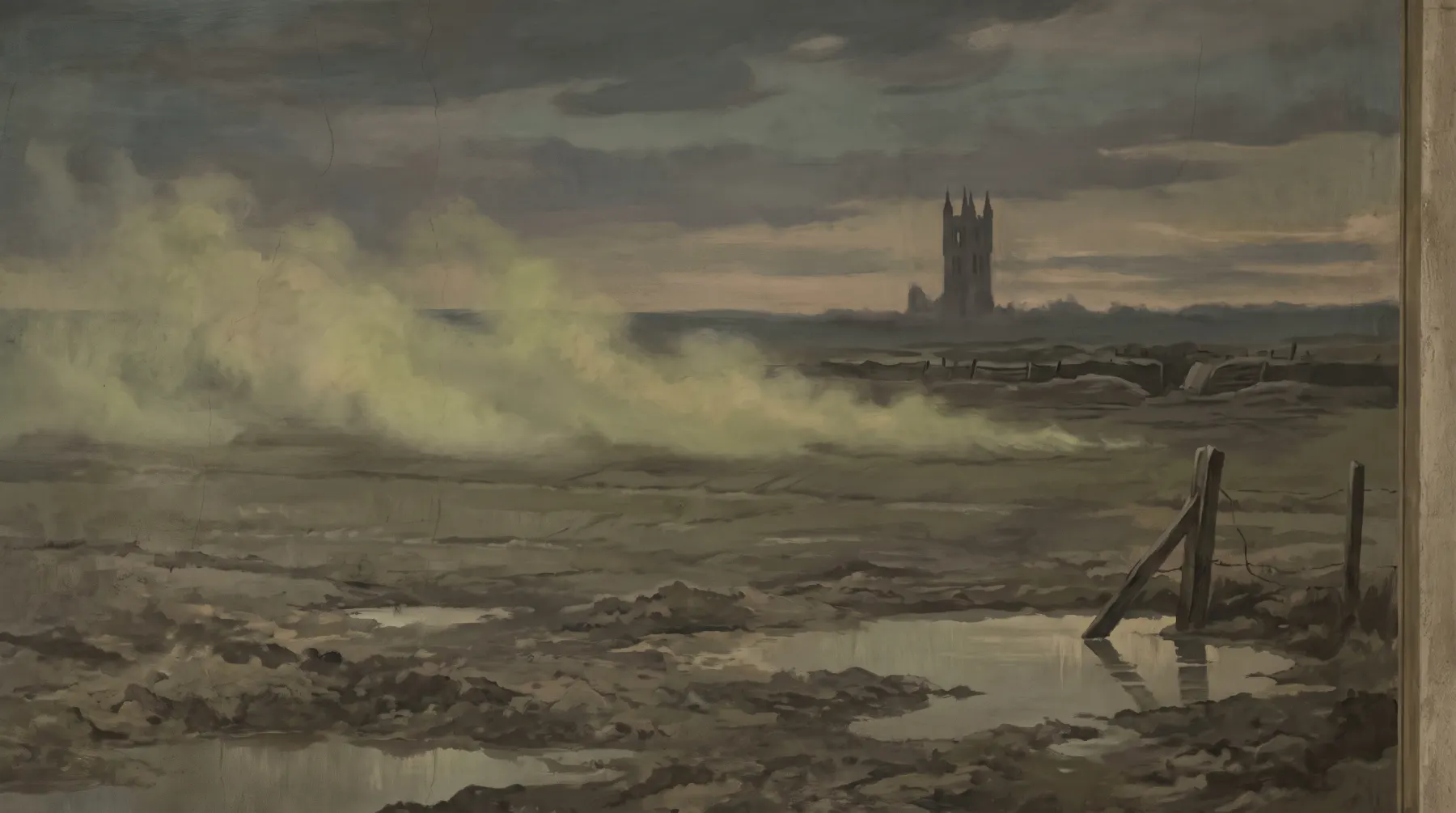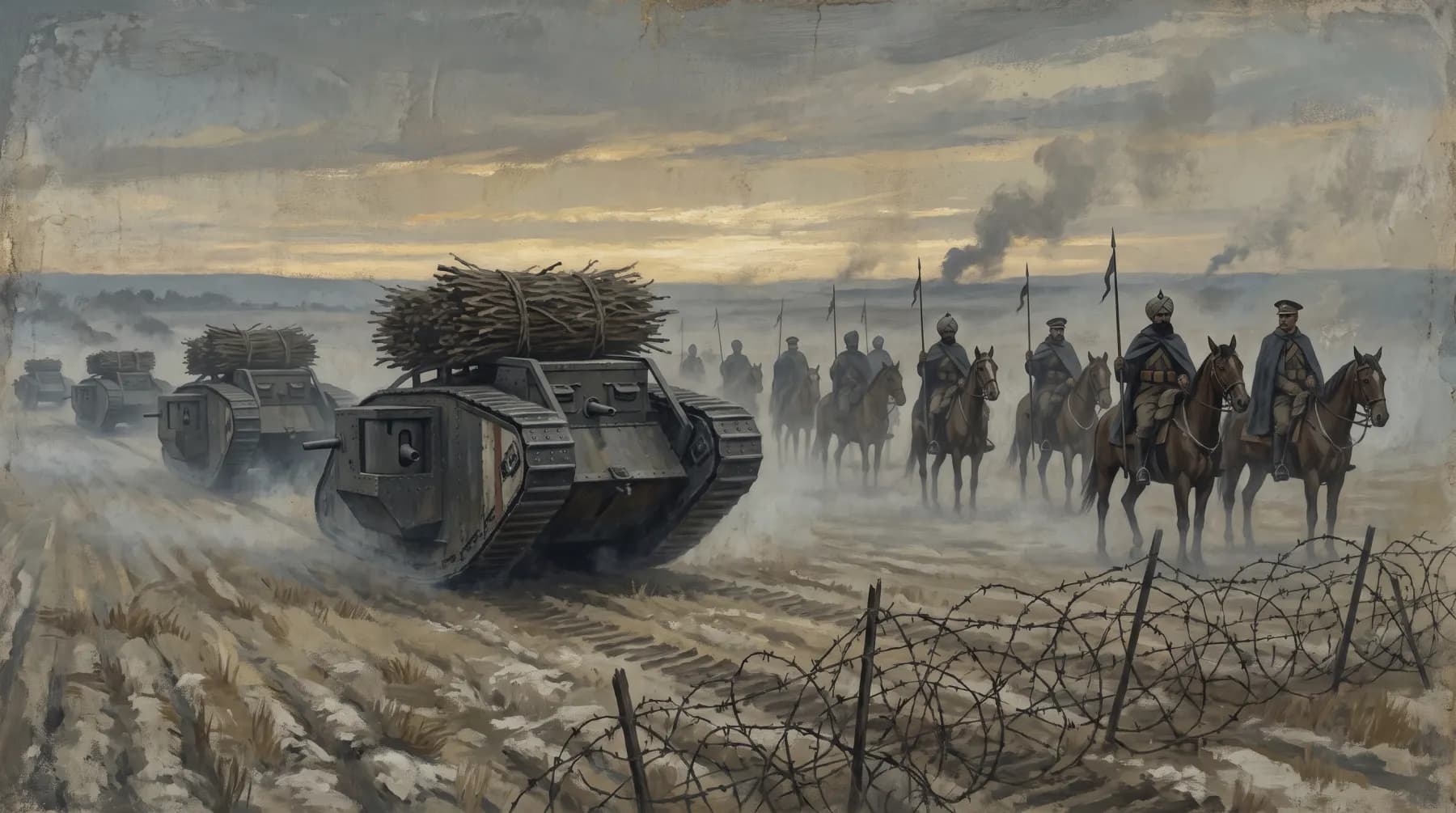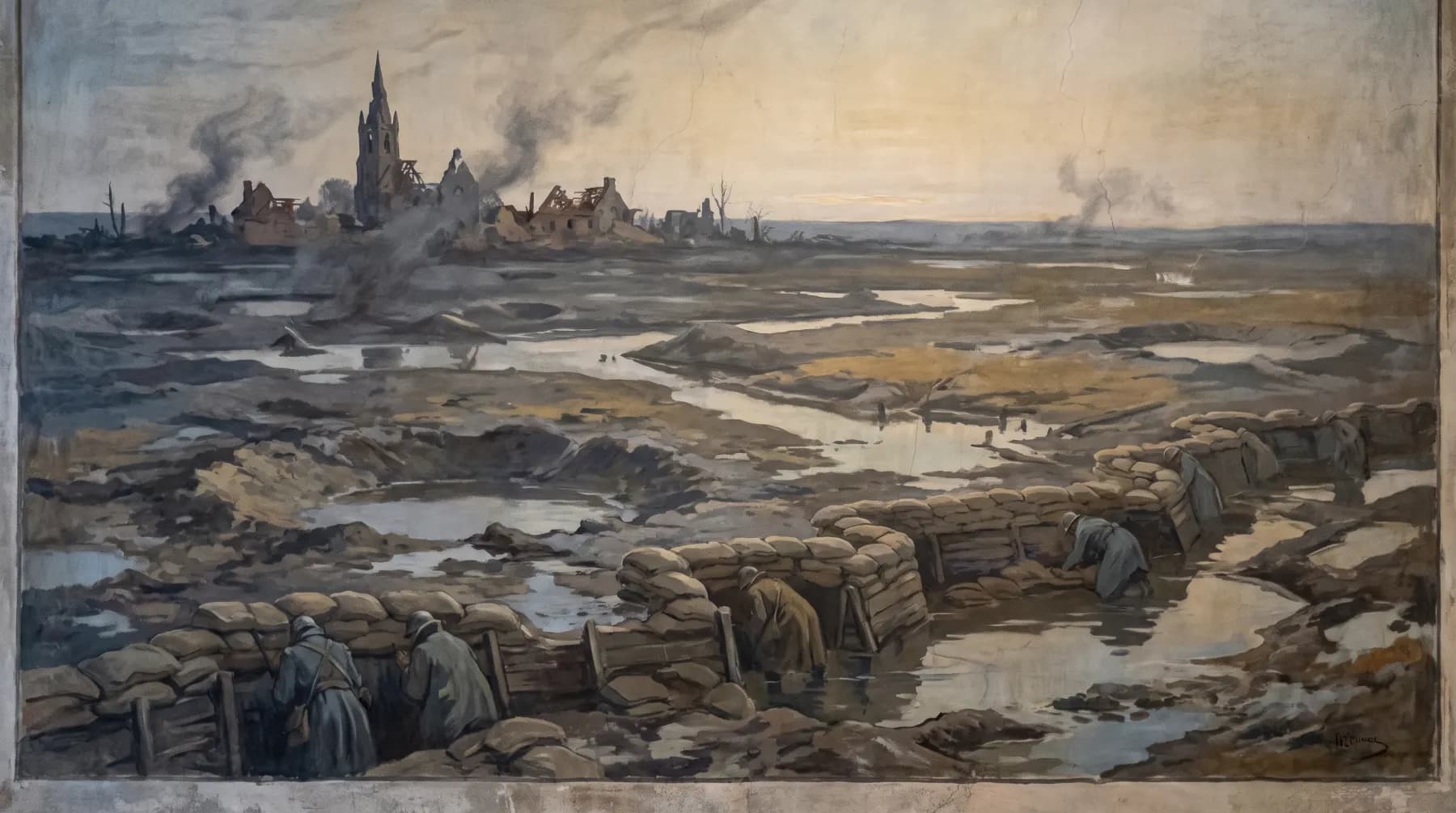
Painted reconstruction of flat waterlogged Flanders farmland at cold dawn, flooded shell holes reflecting a pale sky, with the ruined rooftops of Neuve Chapelle village low on the smoke-covered horizon.

10–13 March 1915

The Battle of Neuve Chapelle

The Indian Corps leads the first planned British offensive

The first fully planned British offensive of the First World War, and the first in which Indian and Canadian troops fought in the same operation under the same command. The Indian Corps delivered the only true breakthrough; Canadian guns and rifles held German reserves away from it.

Artistic historical reconstruction

Dates
10–13 March 1915
Where
Neuve-Chapelle, northern France
Indian formation
Indian Corps (Meerut Division)
Canadian role
Diversion and artillery
Guns in the barrage
530, over 35 minutes
Victoria Cross
Rifleman Gabar Singh Negi

Why this battle is here

Indians made the breakthrough, the British took the village, and Canadians ran the deception that protected the assault — three forces, one operation, in March 1915.

01 — OVERVIEW

The first battle the British planned from the start

Neuve Chapelle brought British IV Corps, the Indian Corps and the Canadian Division into one coordinated operation for the first time.

The Battle of Neuve Chapelle was the first fully planned British offensive of the First World War. It brought together the British IV Corps, the Indian Corps and the Canadian Division in a coordinated operation aimed at breaking the German line, capturing Neuve Chapelle village, and advancing toward the strategically vital Aubers Ridge.

It was the first major Western Front battle in which Indian and Canadian troops fought in the same operation, under the same army command, facing the same enemy. The main assault ran from 10 to 12 March; Haig suspended operations on 13 March.

The plan

The British First Army under Haig planned a 2,000-yard breakthrough using 530 guns delivering a 35-minute surprise bombardment, with the infantry assault at 8:05 a.m. on 10 March. The Indian Corps attacked south of Neuve Chapelle, British IV Corps attacked through the village, and the Canadian Division conducted diversionary rifle and artillery fire north of the main assault to pin German reserves.

Speed was essential. Only about 2,000 Germans held the immediate sector, but up to 20,000 reinforcements could arrive within twenty-four hours.

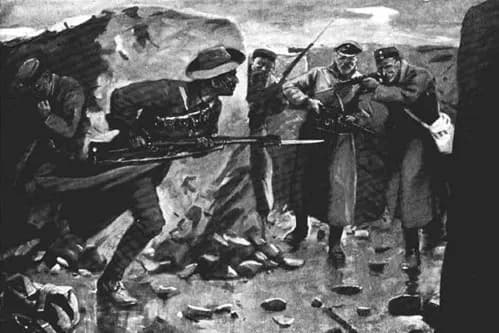
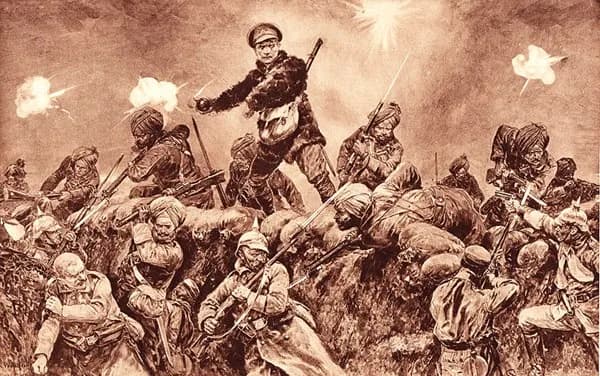
Period illustration of Indian troops charging German positions at Neuve Chapelle in 1915.
Indian troops charging German positions at Neuve Chapelle, 1915. First published in The Great War, ed. H. W. Wilson, 1916.Historical image · provenance and reproduction rights to be confirmed

02 — THE GROUND

Flat, waterlogged and overlooked

A devastated landscape of flooded fields, shallow trenches and a single stream — with German observation from Aubers Ridge.

  • Flat, waterlogged fields that slowed movement and made deep trenches impossible.
  • Shallow trench systems and broken drainage, forcing troops into breastworks built upward rather than dug down.
  • Layes Brook, a deep stream cutting across the front.
  • Bois du Biez, a shell-torn woodland used by German defenders.
  • Aubers Ridge, elevated ground offering excellent German observation over the whole battlefield.

The terrain exposed attacking troops to machine-gun and artillery fire and made coordination difficult. On 11 March thick fog compounded the problem, halting movement at exactly the moment the breakthrough needed to be exploited.

03 — WHO FOUGHT

Order of battle

The Indian Corps spearheaded the assault, British IV Corps took the village, and the Canadian Division shielded the operation from the north.

Operational commanders

General Sir Douglas Haig commanded the British First Army and planned and executed the attack, commanding both IV Corps and the Indian Corps. Lieutenant-General Sir Henry Rawlinson commanded IV Corps on the left, whose 7th and 8th Divisions assaulted Neuve Chapelle village. Lieutenant-General Sir James Willcocks commanded the Indian Corps on the right, including the Meerut and Lahore Divisions.

Formations

Indian Army

Garhwal Brigade — Meerut Division

Delivered the main breakthrough and captured the German front line.

  • 1/39th GarhwalisSuffered heavy casualties and lost all British officers
  • 2/39th GarhwalisCleared trenches traverse by traverse; Gabar Singh Negi's VC action
  • 2nd Leicesters
  • 2/3rd GurkhasNeutralised machine-gun nests and entered Neuve Chapelle
Indian Army

Dehra Dun Brigade — Meerut Division

Reinforced captured trenches; advanced into Bois du Biez.

  • 2/2nd GurkhasAdvanced into Bois du Biez, holding forward positions under counter-attack
  • 1/9th GurkhasAdvanced into Bois du Biez alongside the 2/2nd
  • 2/39th GarhwalisAttached

Indian Army

Bareilly Brigade — Meerut Division

Support battalions; cleared snipers and held advanced positions on 11–12 March.

  • Support battalions

British

British IV Corps

Assaulted and secured Neuve Chapelle village.

  • 21st Infantry BrigadeAssault into Neuve Chapelle. Royal Scots Fusiliers; Middlesex; Wiltshire; Bedfordshire
  • 24th Infantry BrigadeConsolidation and clearing strongpoints. Worcestershire; East Lancashire; North Staffordshire; Sherwood Foresters
  • 25th Infantry BrigadeLeft boundary of the Indian Corps; heavy fighting on 12 March. Rifle Brigade; 1st and 4th Seaforths; 3rd London Regiment

Canadian

Canadian Division

Not part of the main assault. Conducted the diversion that protected the Indian advance.

  • 14th Battalion (Royal Montreal Regiment)Fired rapid volleys at 25 rounds per minute to simulate an attack
  • 16th Battalion (Canadian Scottish)Supported the diversionary fire
  • 2nd Field Artillery BrigadeFired 437 shells in the opening barrage; conducted dummy barrages for three days; fought a 72-hour artillery duel
  • 1st Heavy BatteryShelled Aubers village and hit a German train at Fromelles station
  • 8th Battery

The Canadian contribution

Although not part of the main assault, Canadians played a critical supporting role that directly protected the Indian advance. Their rifle fire pinned German troops and prevented reinforcements moving south toward the Indian Corps, while their artillery disrupted German troop movements and slowed reinforcement routes.

Canadian actions were essential to protecting the Indian assault zone and maintaining the illusion of a wider offensive.

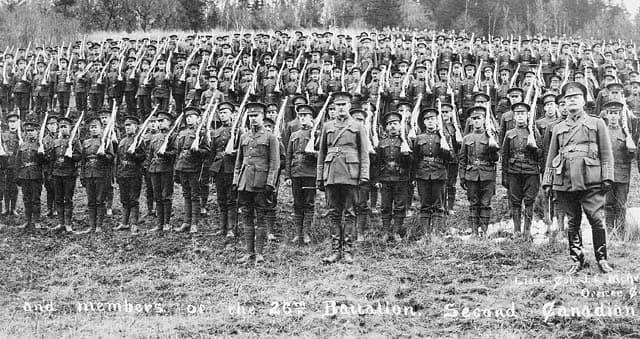
Archival photograph of officers and members of a Canadian Expeditionary Force battalion in 1915.
Officers and men of the Canadian Expeditionary Force, 1915. Supplied in the memorial project's research folder.Historical image · provenance and reproduction rights to be confirmed

04 — WHAT HAPPENED

Breakthrough, fog, and counter-attack

Three days: a successful breach on the 10th, a lost opportunity in the fog on the 11th, and a costly German counter-attack on the 12th.

Sequence of events

  1. 10 March

    Breakthrough

    The bombardment destroyed German wire and trenches. The Indian Corps captured the front line and entered Neuve Chapelle; British IV Corps secured the village. Confusion and misdirection then slowed the advance toward Aubers Ridge.

  2. 11 March

    Fog and lost momentum

    Thick fog halted movement. German trenches were briefly abandoned, but no general advance was ordered. The opportunity to exploit the breakthrough was lost.

  3. 12 March

    German counter-attack

    The Germans launched a massive assault on Port Arthur and Crescent Redoubt. Indian and British troops inflicted devastating losses; over 2,000 German bodies lay in front of the Meerut Division. A final British attempt to retake Bois du Biez failed.

  4. 13 March

    Operations suspended

    Haig suspended the offensive. The village had been taken and held, but Aubers Ridge remained in German hands.

The Indian Corps' breakthrough

The Indian Corps' assault created the only true breakthrough of the battle. The Garhwal Brigade captured the German front line, with the 1/39th Garhwalis suffering heavy casualties and losing all their British officers, and the 2/39th clearing trenches traverse by traverse. Gurkha battalions neutralised machine-gun nests, entered the village, and pushed into Bois du Biez, holding forward positions under counter-attack.

British units fought through the village and supported the Indian advance, but could not push toward Aubers Ridge because of fog, confusion and rapid German reinforcement.

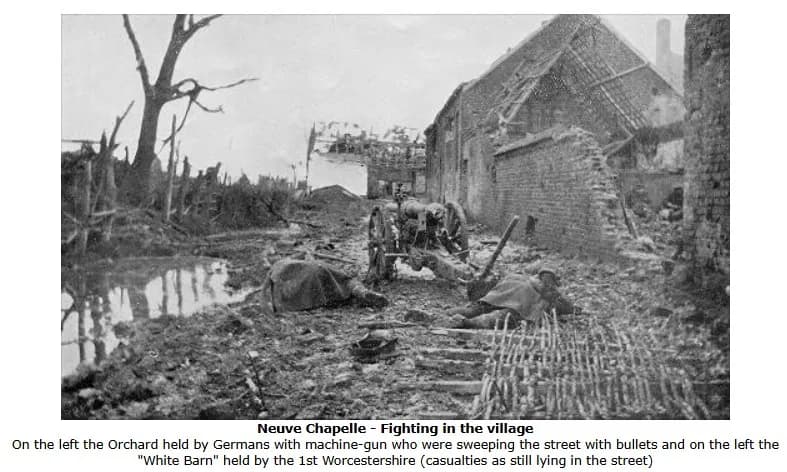
Archival photograph associated with the Worcestershire Regiment at Neuve Chapelle, 1915.
Worcestershire Regiment, Neuve Chapelle sector, 1915.Historical image · provenance and reproduction rights to be confirmed

05 — HONOURS

Awards and acts of courage

Gabar Singh Negi's Victoria Cross, Indian Orders of Merit to Gurkha NCOs, and the first Distinguished Conduct Medal won by a Canadian in the war.

Indian Army

Portrait of Rifleman Gabar Singh Negi

Rifleman Gabar Singh Negi

2/39th Garhwal Rifles

Victoria Cross (posthumous)10 March 1915

Leading a bombing party after his officer was killed, he cleared German trench traverses one by one, drove back defenders, captured prisoners and enabled the seizure of a machine-gun post. He was killed later the same day. His name is also rendered Gobar Singh Negi in some sources.

Jemadar Sangram Singh Negi

Garhwal Rifles

Military Cross

Awarded for conduct during the Neuve Chapelle assault.

Naik Jaman Singh Bisht

2/2nd Gurkha Rifles

Indian Order of Merit

Fought in the assault on Bois du Biez, clearing German snipers and fortified positions, engaging in close-quarters combat, and helping secure the right flank of the Indian Corps under heavy counter-attack.

Havildar Butha Singh Negi

2/2nd Gurkha Rifles

Indian Order of Merit

Led Gurkha troops in the assault on Bois du Biez, clearing German snipers and fortified houses in close-quarters fighting. Under his leadership his men held advanced positions against repeated counter-attacks, securing the right flank of the Indian Corps.

Canadian

Private R. H. Drake

14th Battalion Canadian Infantry (Royal Montreal Regiment), No. 25707

Distinguished Conduct Medal

Recorded in regimental history as the first Distinguished Conduct Medal obtained by a member of the 1st Canadian Division in the First World War.

Albert Edward Roscoe

See the note below — the sources disagree on his rank and battalion

Distinguished Conduct Medal

Rank and unit conflict between sources; see the caveat below.

Under intense German shelling, maintained rapid rifle fire that helped pin German troops and prevented reinforcements reaching the Indian Corps' breakthrough — part of the Canadian diversionary operation.

Frank Magee

1st Canadian Heavy Battery

Recorded for the Canadian artillery action

Rank conflict between sources; see the caveat below.

The 60-pounder guns of the 1st Heavy Battery executed the Canadian deception barrage, fought a 72-hour artillery duel, struck a German troop train at Fromelles and helped destroy a German redoubt — protecting the British and Indian assault and disrupting German reinforcements.

Private John Baxter

Canadian Expeditionary Force

Killed in action; returned home with military honours

One of the first to enlist in London, Ontario when war was declared, having come from England nine years earlier. Killed during the battle; his body was returned to London and received military honours, with a Union Jack over his casket. His commanding officer, Major Balfour, said: “Private Baxter was one of our most reliable men.”

“Our casualties were not very heavy at Neuve Chapelle as we only kept the enemy busy at rapid fire so they dare not send troops to help them.”
A Canadian soldier of the diversionary forceCanadian Letters and Images Project, document 43186

06 — THE COST

Casualties

Roughly 11,200 British and Indian casualties in three days, against about 10,000 German.

ForceCasualtiesNotes
Indian Corpsabout 4,200Heavy losses in the Garhwal and Gurkha battalions
British IV Corpsabout 7,000
Canadian Divisionabout 300, including roughly 100 killedMostly from artillery retaliation and the rapid-fire engagements of the diversion
German Armyabout 10,000

Figures as given in the supplied research. Where a source gives a round approximation, it is shown as an approximation.

07 — LEGACY

A shared sacrifice

Three armies, one operation — and a memorial at Neuve-Chapelle that still carries the names of the Indian dead.

Neuve Chapelle stands as one of the earliest moments where British, Indian and Canadian soldiers fought together in a coordinated Allied operation. Indians delivered the breakthrough. British forces secured the village and held the line. Canadians protected the assault with deception, artillery and rapid fire.

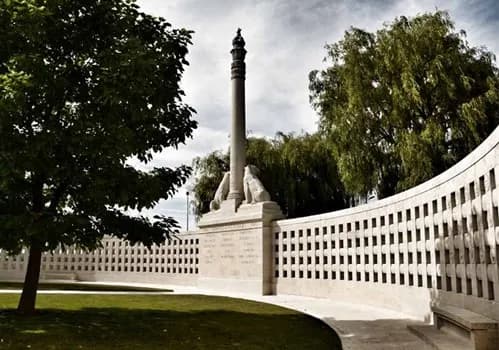
Their combined actions — and shared losses — forged a legacy remembered today at the Neuve-Chapelle Indian Memorial and in Canadian and British regimental histories. The memorial, unveiled in 1927, commemorates more than 4,700 Indian soldiers and labourers who died on the Western Front and have no known grave.

The Neuve-Chapelle Indian Memorial in northern France, commemorating Indian soldiers of the First World War with no known grave.
The Neuve-Chapelle Indian Memorial. Unveiled in 1927, it commemorates over 4,700 Indian soldiers and labourers who fell on the Western Front and have no known grave.Historical image · provenance and reproduction rights to be confirmed

SOURCES

Where this comes from

Every claim in this study is drawn from the works below. Where they disagree or fall silent, the text says so rather than choosing for them.

  1. 01Gabar Singh Negi VCvictoriacrossonline.co.uk
  2. 02The Battle of Neuve ChapelleCanadian History Ehx
  3. 03First DCM Awarded to a Canadian in WW1 Goes to an RMR soldierRoyal Montreal Regiment
  4. 04New Brunswick's Artillery Goes to War, 1914–1915
  5. 05Canadian Letters and Images Project, document 43186
  6. 06Neuve-Chapelle MemorialCommonwealth War Graves Commission